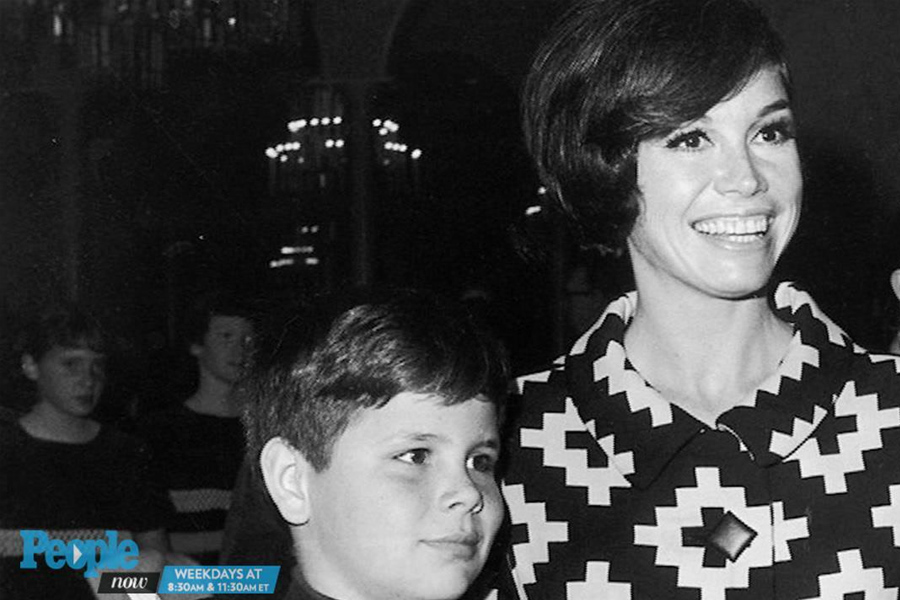
A Life Near Fame
Richard Carleton Meeker Jr., known as Richie Meeker, lived a brief life in the long shadow of celebrity. He was born on July 3, 1956, in Los Angeles, California, during the ascent of Mary Tyler Moore’s career. His name rarely occupied headlines, yet his existence was inseparable from a famous household. That proximity created a peculiar condition. He belonged to public history without ever choosing public life.
Richie was Mary Tyler Moore’s only child. His father, Richard Carleton Meeker Sr., worked as a sales executive and maintained a lower profile. The marriage had begun in 1955 and ended in 1961, when Richie was still young. Divorce introduced an early division into his childhood. From then on, his world was split between a rising television icon and a quieter paternal branch.
Childhood in a Changing Household
Growing up with Mary Tyler Moore meant inhabiting a home touched by motion. Her career moved with speed, first in The Dick Van Dyke Show, then in The Mary Tyler Moore Show. That ascent gave Richie a singular position. He was close to cultural transformation, yet kept outside its glare. He lived amid recognition without becoming its instrument.
This contrast mattered. Children of prominent figures often inherit visibility by default. Richie did not. He remained reserved and largely exempt from the machinery of entertainment. That absence was not failure. It was a form of privacy that held its own dignity. His life unfolded in ordinary intervals, not on set or stage.
Education and Private Interests
By the late 1970s, Richie was a student at the University of Southern California. USC placed him in a serious academic environment inside a metropolitan sprawl. He did not pursue performance or celebrity work. His interests leaned toward tangible matters. He was especially drawn to firearms and became an avid collector.
That collecting impulse suggests a careful temperament. Collectors tend to value order, mechanism, and provenance. They study objects by touch and repetition. They learn the temperament of a device, not merely its appearance. For Richie, that world may have offered structure and intimacy. It also carried responsibility, because the object of interest was never inert.
The culture around firearms in that period was broader than simple ownership. Many enthusiasts approached guns as engineered artifacts. Others treated them as tools requiring discipline and restraint. Richie appears to have lived within that milieu. He was known for attention to his collection, not for public performance. His private habits mattered more than his public record.
The Night of October 14 1980
Richie Meeker died on October 14, 1980, at age 24. He was in his bedroom, watching television, while handling a short-barreled .410-gauge shotgun. The gun discharged and caused an accidental, self-inflicted fatal wound. The Los Angeles County Coroner ruled the death an accident. No elaborate mystery surrounds the event. The tragedy lies in its brevity and finality.
A bedroom is usually associated with rest, routine, and domestic familiarity. That setting deepens the shock of the event. The television continued in the background, ordinary and indifferent. Such details make the moment more human and more severe. Life often changes through small lapses rather than dramatic gestures. Richie’s death reflects that harsh logic with unsettling clarity.
His age intensifies the loss. Twenty-four is a threshold, not an ending expected so soon. It is a year when many lives are just acquiring shape. His was cut short before public identity, vocation, or long adulthood could settle. What remains is a fragment of biography, stark and consequential.
Mary Tyler Moore and Enduring Grief
Mary Tyler Moore had already become one of television’s defining figures by the time of her son’s death. Her career continued, but tragedy altered the texture of her public image. She carried on with work and later advocacy, especially for diabetes research. Yet the loss of an only child leaves a durable interior mark. Fame does not cancel grief. It often only makes it harder to hide.
Moore remained a disciplined and influential presence in American culture. She helped broaden the depiction of women on television. Her performances carried authority, wit, and modernity. Later, her activism added another dimension to that legacy. Still, the death of Richie Meeker sat beneath those achievements like a buried weight. It was a private sorrow attached to a public life.
Family History and Lineage
Richie’s family history included both visibility and distance. Mary Tyler Moore’s parents were George Tyler Moore and Marjorie Hackett Moore. Her family background gave Richie another ancestral layer beyond Hollywood. He also had a maternal aunt, Elizabeth Moore, who died at 21. That fact adds another dim thread to the family record. It hints at how quickly loss can recur inside a lineage.
His father’s life ran in a different register. Richard Carleton Meeker Sr. stayed outside celebrity circulation. He married in 1955, divorced in 1961, and later died in 2013. He was not a headline figure, and that relative obscurity is part of the historical picture. Richie stood at the intersection of those two worlds. One side was luminous and public. The other was subdued and nearly invisible.
| Relation | Name | Lifespan | Note |
|---|---|---|---|
| Mother | Mary Tyler Moore | 1936 to 2017 | Actress and later advocate |
| Father | Richard Carleton Meeker Sr. | 1927 to 2013 | Sales executive |
| Maternal Grandfather | George Tyler Moore | Not specified | Part of Mary Tyler Moore’s family |
| Maternal Grandmother | Marjorie Hackett Moore | Not specified | Family matriarch |
| Maternal Aunt | Elizabeth Moore | Died at 21 | Died young |
Memory and Public Remembrance
Richie Meeker rarely appears as a standalone subject in popular memory. He is usually referenced in relation to Mary Tyler Moore. That arrangement is understandable, but it also compresses his identity. He was not a public performer. He was a son, a student, and a collector. His life was not extended through interviews, archives, or recurring appearances. It was preserved mainly through family memory and brief mention.
This kind of remembrance has a peculiar austerity. A life can be historically real while remaining socially quiet. That quiet can be mistaken for insignificance, but it is not the same thing. Richie’s story endures because it reveals the private cost of public prominence. It also reminds readers that biographies often contain absences as meaningful as achievements.
The Risk of Familiar Objects
Richie’s death carries a sobering lesson about ordinary handling and irreversible consequence. Firearms demand exacting discipline because they do not forgive distraction. A single error can transform a familiar object into a terminal event. That reality applies to collectors, owners, and anyone around such tools. There is no margin for casualness.
The 1980 accident is especially hard to absorb because it occurred during a mundane evening. There was no battlefield, no confrontation, no spectacle. There was a bedroom, a television, and a weapon in hand. The sequence was ordinary until it was not. Such incidents demonstrate how fragile routine can be when danger is embedded in daily practice.
| Date | Event |
|---|---|
| 1955 | Mary Tyler Moore and Richard Carleton Meeker Sr. marry |
| July 3, 1956 | Richie Meeker is born in Los Angeles |
| 1961 | His parents divorce |
| Late 1970s | He studies at USC and collects firearms |
| October 14, 1980 | He dies from an accidental self-inflicted gunshot |
| January 25, 2017 | Mary Tyler Moore dies |
Key Takeaways
Richie Meeker was Mary Tyler Moore’s only child and lived largely outside public entertainment. He was born in Los Angeles in 1956 and died there in 1980 at age 24. His years at the University of Southern California coincided with a private life centered on collecting firearms. His death was ruled accidental after a self-inflicted gunshot while he handled a short-barreled .410-gauge shotgun. The story endures because it joins family fame, private identity, and sudden loss in one brief chronology.